Highlights
“It was me being able to show my value proposition to those hiring managers and say I’m the person who can do what you’re looking for, plus some.”
[4-Week Job Secure]
“No one’s going to be better at telling your story than yourself.”
[Marketing Yourself]
“If a recruiter says to you that they don’t know the compensation for a role that you are being engaged with, that is a red flag, and you should run for the hills as fast as you can.”
[Recruiter Red Flags]
“It’s important that the resume is built properly from the beginning to showcase what your experience, knowledge, and expertise actually are.”
[Insane Metric]
“You need to have an elevator speech about yourself. If you get in an elevator with the most famous CEO of the organization that you’ve always wanted to work for.
You have 10 seconds to get to the 14th floor.
What are you going to say about yourself to them to sell yourself?”
[Standout Interactions]
“As long as you build a strong resume in the beginning, you shouldn’t be, in my opinion, recreating the wheel each time.”
[Cover Letter/Resume]
“The only way to beat an ATS is actually to have clean formatted one-column resume. No pictures, no borders, no graphics, none of that. Just one clean column. That’s how you beat an ATS.”
[Cover letter/Resume]
4-week Job Secure
So you landed your new position (in just 4 weeks) through networking. That’s no tricks, just who you knew or reaching out to new people or what’d you do?
“So honestly, it was somebody who had reached out to me asking for something completely unrelated, and I had just seen it you know, at first you start with the professional response of, ‘Oh, well, I’m no longer here’ or ‘I’m going to be with this organization.’
And then you kind of think to yourself, you know what, why don’t I just put myself out there and say,
‘I’m being laid off. I’m not going to be with this organization anymore, so maybe I’m not best to be that point of contact any longer.’
And that honestly just opened the door to where, as weird as it sounds, they were like, ‘Hey, do you want me to introduce you to my mom who works in HR within the DMV area?’
So I said, ‘Why not? It can’t hurt.’
And I met with his mother virtually, who then opened the door for me to get in for an interview. And so I, after five rounds of interviews, I landed. And again, I’m so happy where I did land.
Balfour Beatty has been wonderful for going on three weeks now.
I’m sure you’ve seen this job market. Everybody’s been out of work for, you know, months at a time, even years for some people. So you landing a new job in weeks, was it?
“Yes. Once I was told I was being laid off, I immediately just started my job search. So I think all in all, from start to finish, it was about 43 days. But a week of that was really just waiting to get aligned for the actual interviews and everything. So it was really just kind of back and forth with scheduling that. So really it was more like a full month, 30 days.
It’s really just kind of marketing yourself right to those in your network because you never know who might know somebody who’s hiring or might have a role open themselves.”
Marketing Yourself
Marketing yourself is an area that a lot of people struggle with, myself included. Any tips as far as that goes?
“Absolutely. And I know it’s always hard to talk about yourself. Most people don’t want to do that. They don’t want toot their own horn. They don’t want to talk about themselves.
But your LinkedIn profile postings, your resume, that is where you should be bragging about yourself.
You should be toting all of those achievements that you had in each of your positions that again will show the impact you bring to any organization.
That if I am a hiring manager, looking at your resume and I can see that you saved that organization from a recruiting standpoint, like even in my own experience, I saved an organization over a million dollars, that’s something that’s going to catch someone’s eye.
If I’m somebody who has new hire onboarding process down to, you know, a two week process instead of a 30 day onboarding process.
That’s something you want tote and champion that advocate for yourself.”

“You can hire all of the headhunters, all the recruiters, all the career coaches that you want, but if you can’t speak to the achievements, the impact that you’ve delivered in all of your roles, why should any organization or manager want to take the chance on you?
So it’s really your own goal should be to headhunt for yourself and be able to tell that story in your resume.
Because recruiters and hiring managers typically take less than 10 seconds looking at resumes.
They’ll scan a resume real quick, pull out a couple of titles or experiences or technology experience that you might have, and that’s what they’re looking for.
So the more that you can showcase that with all of your impact, your value-add to an organization, the better you’ll be.”
So LinkedIn profile, you say that’s pretty important for job seekers.
“I do. In this day and age, especially with social media as big as it is, a lot of organizations, they’ll post roles on LinkedIn a lot of the times or their recruiters are doing confidential sourcing via LinkedIn. So it’s best for you to create a professional profile, not your personal Facebook or Instagram.
This is your professional profile, that again, can showcase that story.
The more likely that an organization or a recruiter will be able to find you and actually engage with you for a position that is posted right now, a position that’s confidentially being sourced right now, or one that isn’t even in the realm of being posted, but they know down the line something’s going to come that align, so they’ll still reach out and start building that relationship.”

Recruiting Success
Going back to showcasing your skills. I was looking through some of your stats that you have on your LinkedIn and you are quite impressive, I gotta say.
“Thank you.”
Your 93% offer acceptance rate over seven years. That’s crazy.

“Yes, and it’s hard to do, especially with a lot of the roles that I was hiring. They were niche positions that required a certain personality to fill the role.
But the success comes from being honest and transparent in the beginning.
I always tell my candidates up front what the role is, when the targeted start date is, what the salary is, the benefits are, everything up front.
As I’m trying to make the decision of if they’re the best fit for us to put forward to the hiring manager, they also need to ensure that we’re the best fit for them.
And the only way to be fair is to be transparent to them.
So that’s how I was able to successfully keep that 93% acceptance rate because from the very beginning I was honest and knew whether or not they’d be interested in the offer that we would eventually end up extending to them.”
That’s easy enough, but I’m sure you’re aware, that’s not the case for every recruiter. Not every recruiter is that transparent.
Recruiter Red Flags
“That’s very true and goes along with your red flag question is that if a recruiter says to you that they don’t know the compensation for a role that you are being engaged with, that is a red flag and you should run for the hills as fast as you can.
Because before a recruiter goes to market and posts a role, they know the budget or range and if they don’t, they’re not posting it yet.
They’re not going to go to market without knowing at least an idea of what the team is looking to pay this position.
So if a job seeker is engaged for a position and a recruiter says that they don’t know the compensation, I would run for the hills and consider that a big red flag.”
“Before a recruiter goes to market and posts a role, they know the budget or range and if they don’t, they’re not posting it yet.”
Recruiter Green flags
So what would some green flags be then for you as far as candidate interactions and that kind of thing?
“I think knowing that a recruiter is responsive.
You certainly don’t want somebody who has engaged with you and now has left you going for weeks and weeks without an update.
That’s not fair to you.
That’s not being honest with you.
I think having a recruiter/organization that is responsive, providing you those timely updates, as well as being transparent with what they’re looking for, those are definitely green flags. Because again, any organization who is recruiting should know what they’re looking for, what they’re able to offer that role, to be able to share that in the first engagement with you.
Whether that’s a phone screen, an email, or in-person interview, they should have those details.
And that’s definitely a green flag I would look for as well – if they have verified recruiters on LinkedIn who are active.
I think that’s also a green flag, in my opinion, as to an organization that trusts their employees to be able to go and build their market brand on social media and bring in those talent engagements that way.
So those would be my green flags from a recruiter seat.”

Communication
As far as the ghosting, as it’s called, you know, going weeks and weeks without hearing anything, what can candidates do to kind of negate that the best they can?
“So when you first apply, sometimes it’s a little hard. Organizations sometimes might take weeks and weeks to review applications.
I mean, some of the places that I actually applied for back in July are just now sending me emails and updates.
And sometimes it will take that time.
But if you’ve actually gotten a response from a recruiter – I always say that if you’ve gotten to the phone screen or interview stage, that you should always ask for an email to where you can send a thank you note with the idea in the background of not only will I send a thank you note so I can get that email from them, but now I also have a point of contact that I can go to if I’m not getting timely updates that I can say,
‘Hey, I interviewed on this day, can you provide me some sort of update?’
Or if they sent you a calendar invite for the phone screen or interview, see who’s listed on that invite. Because a lot of the times it’ll be the hiring managers, so now you have access to them to ask for an update as well.
A job seeker should certainly ask for a point of contact so that they can send a thank you as well as for follow-ups later down the road.”
So, are you for the candidates reaching out to the hiring managers?
“Ideally you should always stick with the recruiter, but if you’re not getting a response from the recruiter, certainly reach out to the hiring manager.
A lot of the times candidates will reach out to me with a thank you note for the hiring manager that I’ll then forward to the hiring manager.
But if you’re not getting response from your recruiter, I would say certainly go to the hiring manager or whoever you do have contact with and ask for an update because it’s only fair that they provide you with that update.”
Insane Metric
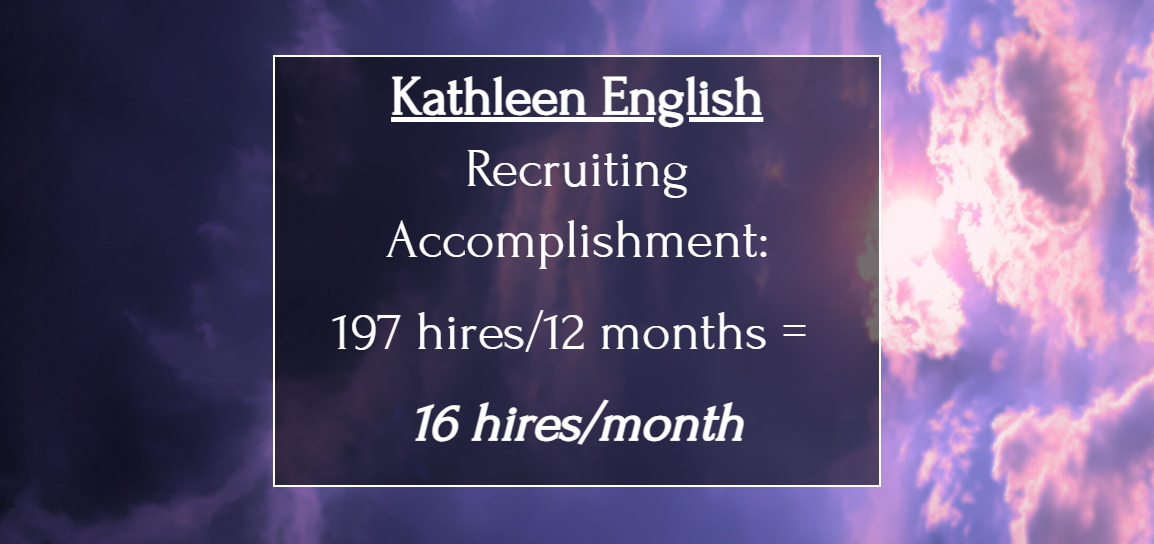
You hired 197 employees in 12 months to launch a new Texas based office.
That’s insane. That’s a lot.
“Yes. So it’s a lot of hires at one time, and it was a whole gamut of different call center operation roles. We had some medical roles down there and were relocating our office from a Pennsylvania location down to a Texas location. So we kind of started fresh down there with all new employees and so I had to get all of those processed.
I am somebody who’s very process driven. Once I have something down, it’s really just the monotonous plugging and chugging per se that I just have to go through.
And I think the largest class we had was 57 people at once. It’s doing all those offers one by one, plugging and chugging and just getting all of that out.
It was interesting. It was a busy season and luckily around the holidays it finally started to slow down a little bit.”
Transferable Skills
So when you’re under such tight scrutiny and time constraints, is that who do you know who to talk to as far as candidates go? Is there any rhyme or reason?
“So it really depends on the role. I am somebody who looks for transferable skills. I’m not somebody who will look for the exact specific skills of the role.
I will look for somebody who maybe doesn’t have the specific HR experience but that has the transferable confidential knowledge, operations, administrative or data-entry experience.
It’s really just knowing what the wish list is of the hiring manager that they’re looking for in the role and kind of what your minimum and your max are.
A lot of the times for entry-level positions, I am somebody who likes to give people the opportunities to prove themselves during a phone screen. So I’ll reach out to almost everybody that has applied that meets the basic minimum requirements of can work Monday through Friday and be in the office.
I’ll reach out to them and see what they can really do and handle. Now I know that they actually need those specific medical or construction experiences that I can kind of pull out some titles or experiences on their resume that again will provide that transferable skill.
Medicals, medical, constructions, construction. No matter what location you go to, it will all pretty much be the same.”
“It’s just being able to know what comparable traits you can use that are showcased on those resumes. Which is why it’s important that the resume is built properly from the beginning to showcase what your experience, knowledge, and expertise actually are.”
Yeah, that’s a big one for me personally because I’ve been in the restaurant industry for 10+ years now and I want to get out, but it’s kind of hard to know the skills that I have that will be successful elsewhere.
“Yeah, it’s hard sometimes when you are looking to change industries. That’s why when you do write your resume, start it with your restaurant experience and include your quantifiable experience in the sense of metrics.
What did you do?
How many or how often?
What was the outcome of what you did?
And that translates to any job really.
So whether you are in the restaurant industry, whether you’re in construction now like I am, or you’re in health care, that pretty much plays across the board to where if you were to pull out how many customers you supported, if you were a waiter or waitress, you can still pull out those quantifiable metrics to say, this is how many people I helped, etc..
And now me as a recruiter looking at that, it’s – you have the time management skills to help all of those people, you have the problem-solving skills to be able to manage multiple tables at once or fix orders, whatever it may be.
So it’s kind of looking at it from a high level to say, okay,
‘What did I do here?’
That now translates into the corporate office or whatever it may be.
And so that’s why it’s important to build with those metrics because that’ll be able to help you see first what you can do without diving into the adjective heavy side of building a resume.”
I want to make sure I heard you right.
Going Back to the 197 employees in 12 months, did you say you talked to pretty much every candidate to see if they were viable?
“For a lot of my entry level positions, yes, I do speak to almost every candidate that does apply just because most of those don’t require any years of experience.
So it’s really just seeing if they have the wherewithal to learn on their feet, the agility to be able to work in a fast-paced environment if that’s the case.
If it’s a niche position that does have those specific skill sets, then I’m only speaking to who meets the bare minimum requirements of the job posting.”
Interview Mistakes
“Well, first and foremost what you’ll hear from a recruiter is you have to go in confidence.
And I think confidence sometimes translates the wrong way.
I think confidence needs to be in why you want the job and not so much as why you need the job.
Because one feels a little heavier and one feels a little bit more powerful to where you’ll be able to focus a little better during the interview and kind of showcase why they need you as opposed to why you need them.”

That’s an interesting way to put it, I mean it makes sense.
A few people that I’ve talked to so far have said always come prepared with questions and I feel like that’s pretty standard.
Anything else to add on to that or anything maybe slightly different that you would add?
“So I do think every job seeker who interviews does need to ask questions. They don’t need to be such formatted questions. But I think the more you ask, the more organic and candid answers that you get will kind of fill in more of the dots as to what this place is really like or what this team is really like.
So sure, you can ask the vacation, you can ask the benefit questions if you don’t get that straight up from the recruiter.
I think what will give you more insight into the organization and role is what does success look like in this role in 90 days? Because usually at any organization you’re not going to get truly onboarded and acclimated until at least the first quarter.
So figure 90 days there – What does success look like?
You can also gauge – Do you think you’ll be able to meet those expectations, or does it sound like they’re asking for too much for what they’re looking for in this position?
So that question will really help give you a lot of insight into the organization, the team, and the position itself that I recommend all of my job seekers ask those questions.
At least that question.”
Standout Interactions
What about with candidates – good, bad, or outlandish interactions?
“Well, I will say that for all job seekers, when you are uploading a resume, pay close attention to what you’re uploading.
You’ll hear from many recruiters that we have opened many documents that are not actually your resume.
I think those are probably the weirdest interactions that I’ve had where I’ve opened it and it’s been a chocolate chip cookie recipe.
I’ve opened it and it’s been a PDF of 50 different memes about love. We’d much rather read your resume.
It’s pretty funny. You never know what you’re gonna get in a day of recruiting.”
What about good interactions? Anything that really stood out to you over the years.
“So I always think that candidates who come prepared, and I don’t mean prepared as in doing the research on the organization.
That’s always a great thing. You should definitely do that.
I mean, coming prepared in the sense of being able to talk about yourself again, it’s not something people like to do. I don’t like to do it.
But knowing what you bring to the table from a professional standpoint is definitely something that I tell all of my job seekers.”
“You want them to be like:
I need to hire this person.
I will not forget this person.
I can’t forget this person.
I need to hire them right now.
It’s a 15-30 second audio cover letter about yourself that for every interview. When you’re asked,
‘Tell me a little bit about yourself’ or
‘What is it that interests you in the role.
You now have a blanket statement that you’re confident about and you can speak to well.
I think that’s always something that if a candidate comes to me during a phone screen or an interview and they come with that polished elevator speech, I know that they can tell a story, they can speak confidently, and they would have no problem with that communication side of a role.
So I would say that’s probably the thing that has stood out to me most with my candidates is who does come in that polished sense and who doesn’t.”
Yeah, definitely easier said than done as we’ve covered.
“I agree with you, it is. And practice does make perfect.
I know a lot of people don’t want to practice, they don’t want to sound like a robot.
But it’s better than you reading your resume off of a screen as being able to speak to it naturally because it is something that you’ve practiced, but it is your story, which is why it comes naturally to you.”
Cover Letter/ Resume
But what about Cover Letters? Do they need to be keyword matched with the job description?
“You’ll get many different answers from many different recruiters.
Me personally, I think the only reason you need a cover letter is if you are coming out of, for example, government sector into civilian sector and you want to showcase your transferable skills in a short little summary.
Or if you are open to relocating, I think you should have a cover letter that states why you’ve applied to this position, that you are relocating or open to relocating, whatever it may be.
I think those are good reasons to have a cover letter. Otherwise, I don’t think it’s necessary.
I do think that your resume should showcase all of what you need. I also don’t think you need to have a resume built for every single position you apply for.
I’m in hr. I’ve worked HR and Talent Acquisition. So no matter where I go, HR and Talent Acquisition are going to do the same essential things. They’re just going to be in different systems with a different organization.”
“So as long as I built a strong HR or TA or combined resume, I shouldn’t have to recreate it each time I apply.
Because every position is going to have the same essential basic functions that are done.
As long as you build a strong resume in the beginning, you shouldn’t be, in my opinion, recreating the wheel each time.”
Some people I’ve talked to are the opposite.
They’re:
‘Every resume has to be exactly like my job post kind of thing.’
“I think that goes with the conspiracy of the ATS.
The Green Goblin behind the curtain that you have to beat, which the only way to beat an ATS is to have a clear formatted resume.
The ATS isn’t only going to pick out keywords, so you can plop in all the keywords you want, but it’s also going to pull on your experience, your years of experience on the different job titles.
You may have had the transferable skills that it pulls out itself.
“The only way to beat an ATS is actually to have clean formatted one-column resume.
No pictures, no borders, no graphics, none of that.
Just one clean column.
That’s how you beat an ATS.”
“Some ATS are built to where they can rank different resumes based on the keywords that are included. But any recruiter is not going to rule you out based on that.
They’re going to review your resume. Even with an ATS, there’s a person still behind the scenes looking at your resume saying,
‘They don’t meet 1, 2 and 3, but they meet 4 through 10, so we’re still going to give them a try.’
So if you meet 70% of the requirements of a role, apply. Don’t pay attention to any of the application numbers on it.
Don’t pay attention to what you’re missing.
If you meet 70%, go ahead and apply. “
Government Positions
Are there any particular tips for somebody either trying to get into a government position or leaving?
“So getting into a government position sometimes all those federal roles are pretty hard to get into.
But nowadays there are so many subcontractors that are working for government contracts that it’s easier nowadays to get into some of those subcontractor type positions, such as, you know, the Department of Defense, Department of State have a contract and they hired a medical organization to handle a medical side or a construction organization to build something for them.
Getting in with those organizations is easier than actually getting a direct federal contract position.
So if they’re looking to get in, that’s a great way to get in, starting there and coming out of the government.
If it’s our military veterans, which of course thank them for their service, but if it is our military veterans, then they should have transition readiness programs dependent on their branch that they should take advantage of all of the services that are offered to them, such as their resume review and writing, their career coaching, their interview prep, because all of that will help not only for them to practice, but along with their military skills, translator.
That will translate all of their transferable knowledge into the civilian sector to not only help them see what they might be eligible for if they don’t already know, but also so that organizations can read the resume and know exactly what they’re talking about and how it translates into one of their positions with the organization.”
Thanks for visiting!
This page brought to you by the following cloud picture.

Contact:
connect@thehireperspective.com